Article: How to Prepare for Your Mid-Year Reset (and Why it's Good for You)

How to Prepare for Your Mid-Year Reset (and Why it's Good for You)
It's May. You're somewhere in the middle of the year, and those goals you set in January? They might feel like they belong to a completely different version of you. The one who had time, the one who was going to exercise every morning, read more books, finally get on top of her finances, and feel completely on it for once.
If that sounds familiar, you're not alone, and more importantly, you haven't failed. You've just gathered six months of information. And that's actually the perfect starting point for something far more powerful: a mid-year reset.
What is a mid-year reset (and why does it matter)?
A mid-year reset is exactly what it sounds like - a deliberate pause, somewhere around the halfway point of the year, to reflect on where you are, recalibrate what matters, and re-focus on the months ahead. It's not about starting over or punishing yourself for what didn't happen. It's about getting honest with yourself in a way that January (with all its pressure and optimism) rarely allows.
Here's the thing about resetting in May or June rather than January: you have real data.
You've lived six months of your actual life and so you know what your mornings genuinely look like. You know which goals energised you and which ones you set because you felt like you should. You know what changed. Maybe you got a new job, there was a difficult season, or a shift in priorities you didn't see coming.
That clarity is so valuable. And it means the second half of your year can be built on something much more solid than just that fresh-start enthusiasm (which we love here by the way, but it’s not sustainable).
Signs you might be ready for a mid-year reset
Not everyone needs a full reset, but most of us benefit from one more than we realise. Here are some signs it might be time:
You've drifted from your goals, but you're not sure when or why. Things started well, and then somewhere around February or March, life got in the way. You're not sure what happened, only that you're no longer tracking or reviewing anything.
You feel busy, but not productive. You're doing a lot. But when you look back at the week, it's hard to point to anything that moved the needle on the things that actually matter to you.
Something in your life has shifted. A new job, a house move, a relationship change, a health challenge. The goals you set in January were written for a version of your life that no longer quite exists.
If any of these feel true, a mid-year reset isn't an admission of defeat. It's a sign that you're paying attention.
Why mid-year is actually the best time to reset
We tend to think of January as the natural moment for new beginnings, and there's nothing wrong with that. But mid-year has some real advantages that January simply can't offer - let me explain.
- By mid-year, you have context. Six months in, you know things about yourself and your life that you just didn't in January - what you actually have the energy for, what genuinely matters versus what looked good on a vision board, which commitments are realistic and which were optimistic.
- You still have time. This is important. A mid-year reset in May or June still leaves you with six months to make meaningful progress on the things that matter. That's not a small amount of time. That's enough to build a new habit, finish a project, shift the direction of something important.
- There's no noise. January comes with such a big social pressure - the "new year, new you" messaging is everywhere and can be motivating for a while. Mid-year is so much quieter. No one is really posting transformation content in June, which means the goals you set now are more likely to be yours - chosen with intention, not because you felt swept along by a cultural moment.
- It's a gift to your future self. Think about where you want to be in December. Not in a goal-obsessed, achievement-at-all-costs way, just really honestly. What would feel good to have done? What would you regret not starting? A mid-year reset is how you give your future self a fighting chance.
How to prepare for your mid-year reset
So now that you’ve realised that you need a mid-year reset, how do you get started?
Firstly, this doesn't need to be a full-day event (though if you can give it an afternoon, that's great! I love taking a half day and sitting in a coffee shop to do this - make it into a date just for yourself!)
Here's a simple way to approach your mid-year reset.
Step 1: Carve out dedicated time
Treat this like an appointment with yourself, not something you'll get to when you have a spare moment, but something scheduled in - be intentional about it. Even 90 minutes of quiet, uninterrupted time is enough to get real clarity. Block it in your calendar, make a cup of tea, put your phone in another room.
Step 2: Gather your materials
Pull out your planner, your journal, your notes from January - anything you've been using to track or review your year (even loosely) or keep notes of your ideas and goals. If you've been keeping things in your head rather than on paper, that's fine too - you're just trying to get everything in front of you at this stage.
Step 3: Do a quick life audit
Before you look at any specific goals, take a step back and ask yourself: which areas of my life feel good right now? Which feel off? This doesn't need to be complicated - you can simply think across a few categories like the following and notice where there's ease and where there's friction:
work/business
health
relationships
finances
personal growth
home
Step 4: Review your original goals (without judgment)
Go back to what you set in January, or whenever you last did any kind of planning. For each goal or intention, ask yourself honestly: does this still matter to me? Has anything changed that makes this goal less relevant, or more urgent? Some goals will still be exactly right and others will have become irrelevant. Both are fine.
Step 5: Set your focus for the second half of the year
Rather than rewriting a long list of goals, identify one to three focus areas for July to December - just the things that genuinely matter. When you concentrate your energy on fewer things, you make real progress rather than spreading yourself thin across everything.
"This is also a good moment to think about how you'll hold yourself to these intentions and take action. A planner that you actually use is worth far more than a beautifully written list that lives in a notebook you never open, and will actually help you take action on those intentions."
The tools that support a reset (and make it stick)
One of the most common reasons resets don't stick is the lack of a system to hold them. You do the thinking, you feel the clarity, and then you go back to your normal life, and within a few days, the momentum has faded.
Two things are important here: creating an implementation plan and writing it down.
Writing things down by hand makes a real difference here. There's something about the physical act of putting pen to paper that helps you think more slowly, more honestly, and more deliberately than typing on a screen. It's not just nostalgia - research consistently supports the connection between handwriting and retention.
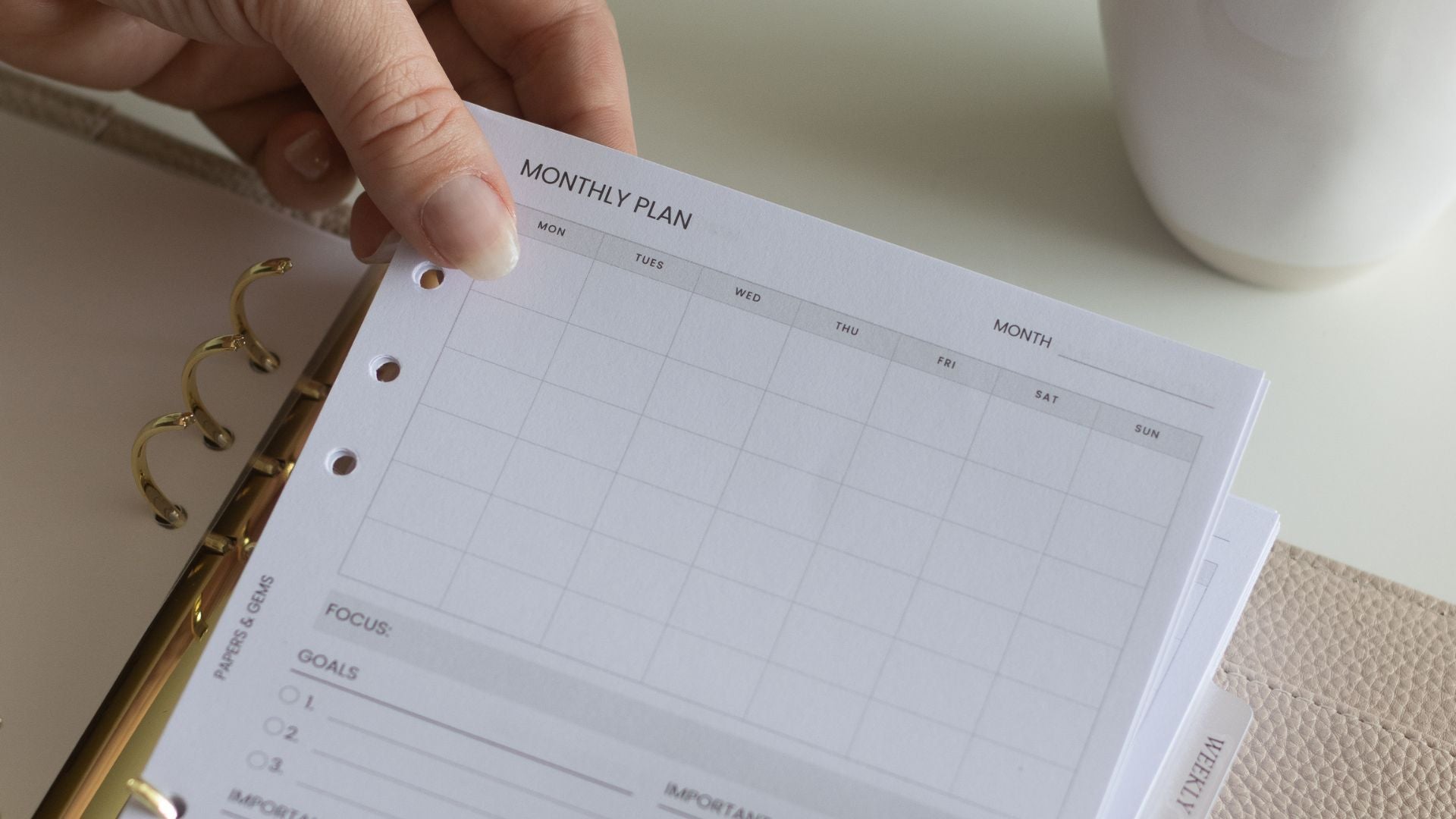
A dedicated planner system gives your reset somewhere to live and momentum to take action. Not just the goals themselves, but the weekly plans, the monthly check-ins, the small daily intentions that turn a decision into a habit. When everything is in one place (and it's something you actually enjoy opening and using), it becomes part of your rhythm rather than another thing on your to-do list.
This Papers & Gems Planner is designed exactly for this kind of intentional, calm approach to planning. The binder format means you can build a system that works for your life - adding, removing, and rearranging as your focus shifts. And it’s undated, so you can start any time. It's the kind of planner that grows with you, rather than making you feel behind the moment you miss a week.
"Use a planner with the customisable inserts so you can shape your day based on your natural energy rhythms, not a rigid routine."
OUR RECOMMENDATIONS
You haven't failed. You've gathered information.
Here's what's worth remembering as you go into your mid-year reset: the fact that things didn't go to plan in the first half of the year isn't evidence that you can't do this. It's evidence that you're human, that life is unpredictable, you need a system to support you and that the goals you set in January were made with incomplete information - you have much better information now, six months of it.
Use it. Set aside an afternoon this week (remember, you need to keep the momentum going) - not next month, not in the autumn, not when things settle down. This week. Give yourself the gift of a clear, honest look at where you are and where you actually want to go.
If you need inspiration to set up your planner, read this blog post: How to Set Up a Binder Planner System for Your Spring Reset (and Actually Stick to it)